

By Marinne Hammond
“The thing that is really hard, and really amazing, is giving up on being perfect and beginning the work of becoming yourself.”
Growing up, and especially once I was an undergraduate student, I would hear people around me promoting self-care as a way to prevent from becoming exhausted. Some common phrases were: “Don’t stay up too late doing homework,” “Treat yourself every once in a while,” or “Find something to take your mind off of work.” It wasn’t until I was a graduate student in clinical psychology that I learned from my professors how self-care is actually an ethical requirement for being an effective therapist. This really changed how I viewed and esteemed self-care. Before I learned about self-care in an ethical context, I saw it as something that only affected my own quality of life. Now, I see self-care as a behavior that impacts the well-being of those around me, especially in my work as a therapist. If I can’t meet my own needs, how can I possibly help someone else meet theirs?

This fresh outlook on self-care aligns with current research; Riegel et al. (2024) discovered that for caregivers, self-care predicted more active coping (making a concerted effort to overcome an obstacle; Smyth & Yarandi, 1996) and less avoidance coping (dismissing an issue rather than facing it). This finding implies that self-care may put you in a better position to confront challenges, especially if you are tasked with helping others. It may seem like self-care is taking precious time away from your productive day, but it may be the very thing that is helping you to resolve the issues that trouble you the most.
You might be asking yourself: If self-care is as important as research suggests, then what are some specific ways I can put this into practice? One place to start is with healthy sleep.
For example, one study examined previous research on sleep quality interventions and mental health (Scott et al., 2021), which included over 8,000 research participants combined. The researchers concluded that depression, anxiety, and stress could all be reduced as a result of higher sleep quality. So, in addition to what we traditionally see as helpful for mental health (i.e., therapy and medication), prioritizing sleep seems to be pretty important, too. In fact, we have a comprehensive sleep module on our website where you can learn more about why sleep is so pivotal to our well-being.
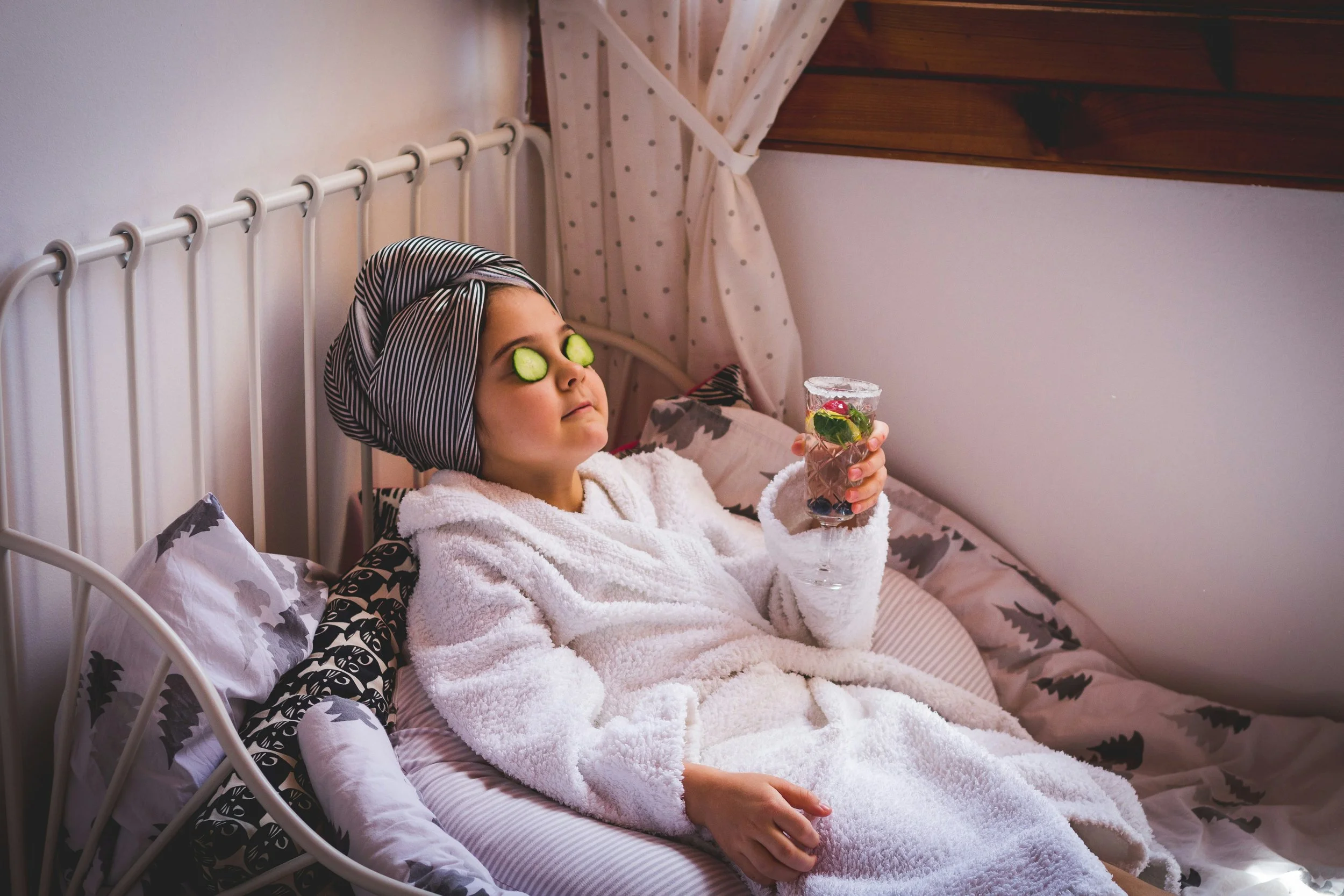
What I love about self-care is that it can actually be quite a creative process. You get to decide what it looks like for you. Ask yourself questions like, “What rejuvenates me?” or “What do I genuinely look forward to doing?” If you’re wondering where to start, here are some ideas:
Listening to music or podcasts you enjoy while tackling your to-do list
Regularly Facetiming loved ones that live far away
Having at least one book on hand that you can read for fun (even if you have other required books you read for work or school)
Setting clear boundaries around the time you spend working (for example, “At 6pm, I’ll stop checking my email inbox for the day).

All in all, taking care of yourself can benefit you and others around you. It may take repeated practice for it to feel like a natural part of your daily routine. If you find yourself struggling with implementing self-care in your life, our Personal Growth Module has a section on building effective habits.
“Take the time today to love yourself. You deserve it.”
References
Riegel, B., Barbaranelli, C., Stawnychy, M. A., Matus, A., & Hirschman, K. B. (2024). Does
self-care improve coping or does coping improve self-care? A structural equation modeling study. Applied Nursing Research, 78, 151810. https://doi.org/10.1016/j.apnr.2024.151810
Scott, A. J., Webb, T. L., Martyn-St James, M., Rowse, G., & Weich, S. (2021). Improving sleep
quality leads to better mental health: A meta-analysis of randomised controlled trials. Sleep Medicine Reviews, 60. https://doi.org/10.1016/j.smrv.2021.101556
Smyth, K., & Yarandi, H. N. (1996). Factor analysis of the Ways of Coping Questionnaire for
African American women. Nursing Research, 45(1), 25–29. https://doi.org/10.1097/00006199-199601000-00005