

By Winslette Quiray
“The passion for stretching yourself and sticking to it, even (or especially) when it’s not going well, is the hallmark of the growth mindset.”
Last August, my family and I went to Bryce Canyon National Park for a short summer trip. Coming from a tropical country where our key tourist destinations were white-sand beaches, I was thrilled and amazed to witness the beauty of these unique rock formations.
As the sun rose, its light reflected on the rock formations, showing beautiful shades of red and orange. It was magical! I came to learn that those rock formations we see in Bryce Canyon are called hoodoos. They are tall, thin spires of rock formed by millions of years of erosion.
After a few moments, we commenced our hike down the Queen’s Garden and Navajo Loop Trail. I could not contain the wonder I felt looking at these hoodoos so closely. With my shoes feeling the rough gravel and terrain, I could not help but wonder how much weathering it took for them to look as grand and majestic as they did. I searched for more information about them once I got home.
According to the National Park Service (2021), Bryce Canyon’s hoodoos are formed through the combined processes of weathering and erosion. The park’s rock layers, made of limestone, dolostone, mudstone, siltstone, and sandstone, gradually break down due to water, ice, and changes in temperature. During the winter, water seeps into cracks in the rocks, freezes, and expands, widening the cracks. This process is called frost wedging.
As these cracks grow, the rock walls develop holes called windows. Eventually, the tops of these windows collapse, leaving behind tall, thin rock spires called hoodoos. Rainwater also dissolves the minerals that hold the rocks together and help shape Bryce Canyon’s unique formation and landscape.
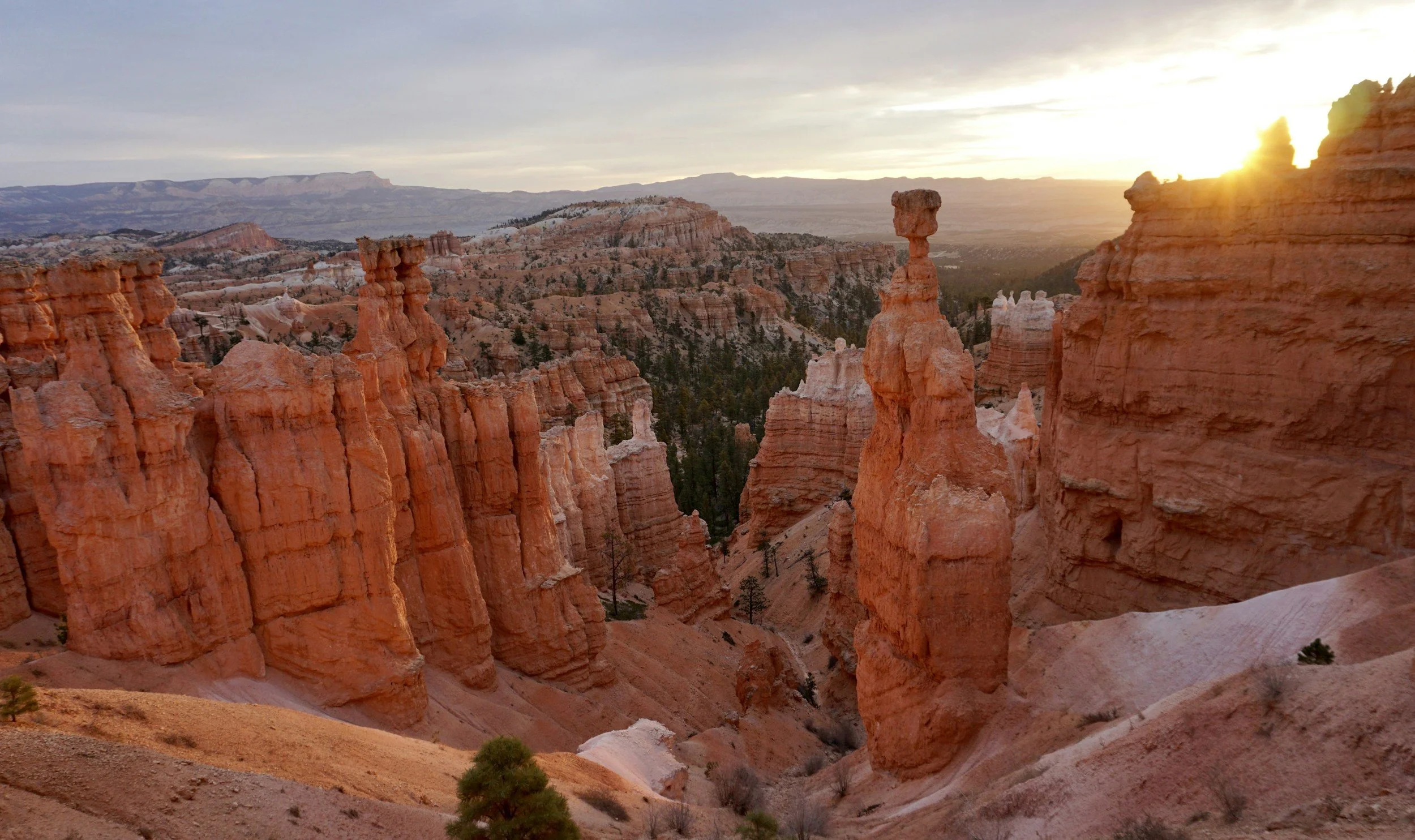
Upon learning this, I saw the parallel of my life experiences to the formation of hoodoos. All the skills I have learned, talents I have developed, and choices I have made symbolize the layers of rock. I try to build them one by one, often finding myself struggling with perfectionism, only to become disappointed when water, ice, and temperature changes break them down. These symbolize my imperfections, mistakes, setbacks, and life circumstances in general.
In the seemingly slow and sometimes painful process of weathering and erosion, it is so difficult to remain hopeful for a positive outcome. More often than not, it is easier to avoid doing hard things and to view ourselves as failures.
And yet, Bryce Canyon’s hoodoos remind me that there is beauty in the process of becoming. Their formation took millions of years of weathering and erosion, and they continue to change as nature shapes them (National Park Service, 2021). What we see today is the result of countless changes that happened gradually, even when those changes might not have been visible to us.

When we are in the midst of weathering and erosion, we should remember to have a growth mindset. A growth mindset is the belief that human capacities are not fixed but can be developed over time through learning and effort (Dweck, 2006; Ng, 2018).
How we see ourselves and our capabilities profoundly affects our behavior and our future. When we view our setbacks, mishaps, and stresses not simply as challenges and obstacles but as opportunities for growth and learning, we can be inspired not to give up but to continue to make an effort and show up (Purdue Global, 2024). We need to understand that life’s obstacles and resistance are needed and can contribute to our growth, just as rainwater, ice, and temperature changes help form hoodoos.
To clarify, this does not mean that we enjoy every struggle or that effort alone guarantees success, but rather, developing a growth mindset means being willing to learn from our experiences, recognize there is room for improvement, and adjust our approach when necessary (Ng, 2018). Just as hoodoos take time to form, personal growth requires patience, persistence, and a willingness to embrace the process.
Drawing from Purdue Global (2024), here are three things we can do to develop a growth mindset:
Focus on your positive actions rather than traits
Focusing too much on the traits and talents can lead to reinforcing a fixed mindset. However, focusing on the positive actions we take to achieve our goals will help us become more growth-focused.
Change your perspective on failure
Remind yourself that failure is an opportunity to learn and that, through it, we can discover what we need to improve or whether we need to change course.
Celebrate the success of others
A common phrase is, “Comparison is a thief of joy.” Understand that there is enough room for everyone to grow and improve. Be happy for others, congratulate them on their successes, and learn from them by asking how they did it.
“First say to yourself what you would be; and then do what you have to do.”
References
Dweck, C. S. (2006). Mindset: The new psychology of success. Random House.
National Park Service. (2021, September 4). Hoodoos. U.S. Department of the Interior. https://home.nps.gov/brca/learn/nature/hoodoos.htm
Ng, B. (2018). The neuroscience of growth mindset and intrinsic motivation. Brain Sciences, 8(2), Article 20. https://doi.org/10.3390/brainsci8020020
Purdue Global. (2024, January 8). What is a growth mindset and how can you develop one? https://www.purdueglobal.edu/blog/careers/develop-growth-mindset/