
By Sarah Odiorne
“You carry so much love in your heart. Give some to yourself.”
How do we grow? Do we look to our siblings or our parents? Do we rely on our favorite social media influencers or friends? What about our religion or values?
Here is the question that has been on my mind: Am I growing?
Like you, my life is not perfect. I noticed this when a manager reprimanded me for something that I felt was unfair, when a friend group left me out of activities, and when I had an illness growing up that affected me until almost 18 years old. Do any of these seem familiar? That is because they are common experiences felt by many. When difficult trials arise, we can either choose to be “better or bitter,” as my mom taught me. Let me set the stage.

Once upon a time, there was a little girl who wanted to feel loved… surprise, that is me! Let me focus on a more specific experience where this girl learned what personal growth meant to her. When COVID first started, the world flooded with confusion and anxiety. Grocery stores were running out of, at least to me, the most random products. Thankfully, this was the most that I ever felt like COVID caused any stress in my life. For me, COVID was a time of self-discovery and growth. As someone who grew up focusing on others and how I could get them to like me, this worldwide pandemic gave me an out. I was not allowed to see other people. I could not interact with them face to face. Suddenly, the expectations I was holding for myself on how to be the perfect friend were not needed. I remember vividly, one night I sat in bed, pulled up a show, and watched it with complete peace of mind. In that moment I felt immense joy and gratitude towards my God, and this time I had to reflect. As our shutdown progressed, I learned how to be ok being by myself. I grew to love it. And that experience taught me a life lesson that I will never forget.
Now, I am aware that COVID was not the best experience for some people. Some may have experienced immense frustration and sadness during that time. I am not discounting that. What I do want to do is show the beauty of personal growth in diverse ways. It is different for everyone. Sometimes we are the ones that fall and have to get back up, like when a Christmas tree fell on me when I did not run away quickly enough. Other times, it is those around you who fall, and you can choose whether or not to learn from them, like seeing my siblings get in trouble for not keeping their curfew.

Thankfully, there are many ways to grow and many studies to help us know how to grow. Specifically, I want to focus on self-compassion and perfectionism. Bearden et al. (2024, p. 2903) conducted an experiment to see how mindfulness impacts perfectionism, anxiety, stress, social connectedness, and self-compassion with post-secondary students. They studied a group of students who self-enrolled in a mindfulness program, and their control group was pulled from first- and second-year psychology classes. They found that those who completed the mindfulness program had more self-compassion and mindfulness along with decreased levels of anxiety and stress. Thus, supporting their hypothesis that mindfulness improves the general well-being of post-secondary students by decreasing feelings of perfectionism and increasing habits of self-compassion. It is important to note that this study shows that perfectionism has an inverse relationship with self-compassion. Thus, as we practice growing, we can see our self-compassion increase and perfectionism decrease.
Now there are two kinds of perfectionism. There is maladaptive perfectionism, which is focused on unrealistic expectations and rejects reality, and adaptive perfectionism, which accepts human limitations and accepts reality (Tribe, n.d.). It is important to find a balance between creating and accomplishing goals while celebrating success and your growth. Thus, adopting adaptive perfectionism is the beneficial approach to perfectionism that will positively influence your growth. Unless specified, future references to perfectionism will refer to maladaptive perfectionism.
One study done by Neshat et al. (2024) found that those who lean towards maladaptive perfectionism often have increased interpersonal sensitivity due to heightened fears of rejection and judgment. This causes them to often misinterpret the neutral reactions and extra-linguistic cues of those around them. They also found that those who lean towards perfectionism have decreased self-compassion. Neshat et al. (2024, p. 115) states, “As a result of the activation of the threat system, the individual experiences distress over what has occurred, and the soothing system associated with self-compassion is deactivated, resulting in self-criticism and the perception of negative experiences as individuals rather than as a shared human experience.” This is one example of just how dangerous leaning towards maladaptive perfectionism can be for your health and psychological well-being.
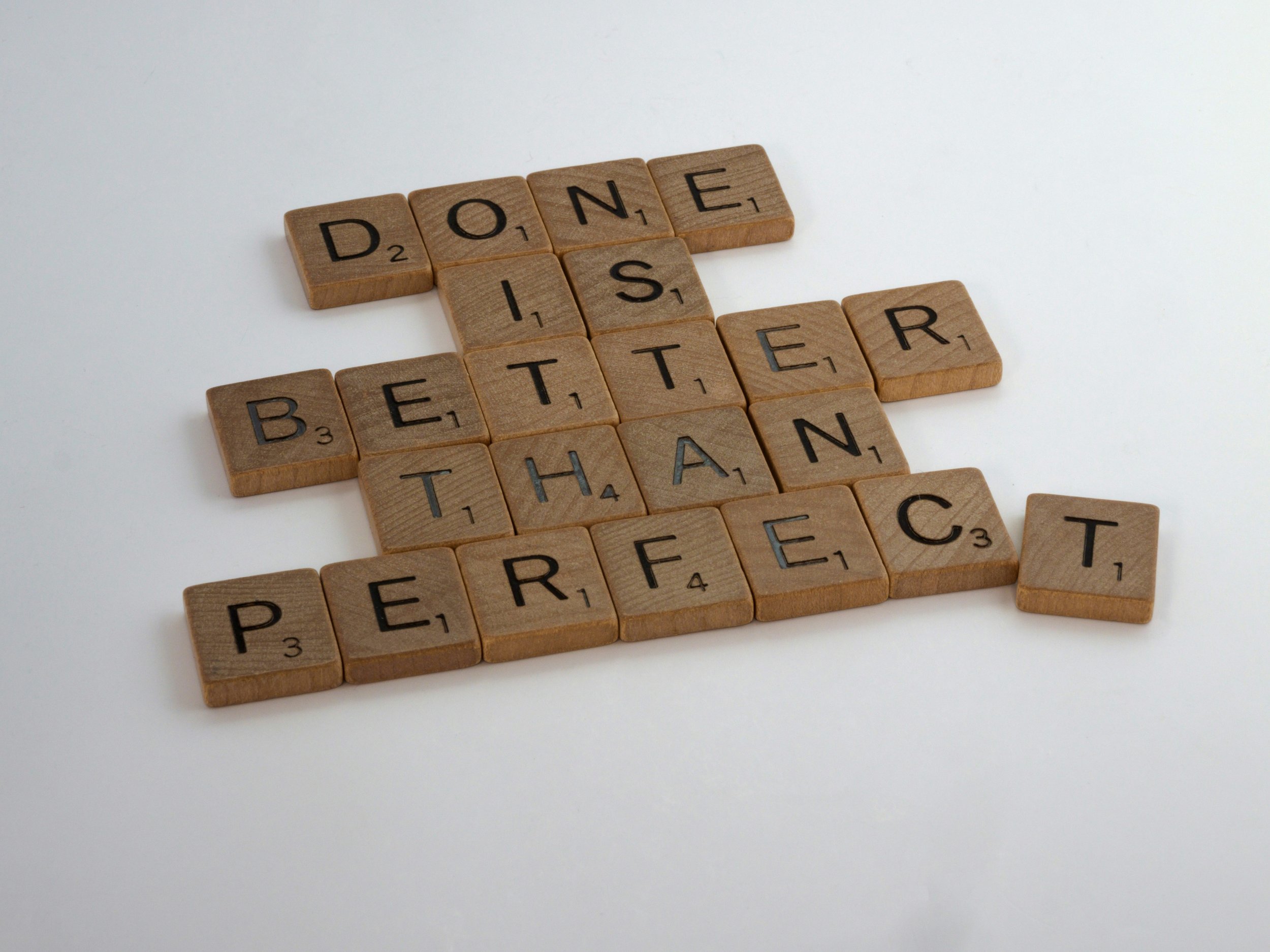
Here are 5 suggestions for developing your own personal growth!
Practice self-compassion—It can be hard to improve at something if you are not patient with yourself while working towards your goals! Practice letting yourself accept any emotions passing through you and view them with kindness and love. This is especially important after your threat system is activated. As Neshat et al. (2024) stated, your threat system turns off your soothing self-compassion system. Rebooting this system is essential to continuing your trajectory to living your values.
Write down the details—After setting an achievable goal, write down steppingstone steps to get you there. Part of this process can involve potential obstacles and how you will overcome them. An even greater part includes keeping track of the efforts you make each week to draw closer to your goal! Give yourself credit for however much or little you do, and do not give up if you miss a few days!
Establish Your Values—Take 5-10 minutes to sit down in a quiet place and consider what values you hold dear to you. Write down your top five and keep them on hand while completing your goals. Having your values clearly outlined will help you focus as you work towards your goals. You can refer to them as needed rather than keeping them as something abstract in your mind. If you have difficulty coming up with values, you can go to the Values module on ‘My Best Self’ for more exercises: Exercises for defining and living your values — My Best Self 101. They have some great practices to help you brainstorm!
Rely on others—Find one person or a group who can help support you and hold you accountable. You also do not have to put all of our eggs in one basket. If you are not comfortable with sharing your goals with anyone, choose something else! If you are spiritual, rely on your higher power for support. You can also pick a teddy bear or a book. The point is to pick something that you can talk to about your goals. Having a partner in crime is extremely helpful when working towards personal growth. Just being able to talk out loud about the progress you make will help keep you disciplined.
Start Now!—It is never too late to start growing. It may seem hard or like it is too late; I know I have felt that way before, and I am only in my early twenties, but it is not! Accept that this may be scary or extremely hard for you to do and show yourself that you are brave enough to do it! Cırcır & Tagay (2024) studied optimism and self-compassion to see if they relate to the relationship between cognitive flexibility and perfectionism. They found that adolescents’ relationship between cognitive flexibility and perfectionism was positively impacted by self-compassion and psychological well-being. Interestingly, optimism did not influence an adolescent’s cognitive flexibility. It would be beneficial to research how they defined optimism, as it is often misinterpreted.

The research that Cırcır & Tagay (2024) conducted shows just how powerful and important increasing your self-compassion is. If adolescents had such beneficial results, imagine how it will help you! And if you are an adolescent, congratulations! You now know just how much practicing self-compassion will help decrease maladaptive perfectionism and improve your psychological well-being. My Best Self 101, incidentally, has some great practices to get you started! https://www.mybestself101.org/self-compassion. Peruse through the module to see what ideas stick out to you.
In conclusion, practicing self-compassion and lowering habits of perfectionism will greatly improve your trajectory towards your personal growth. While there are many other ways to improve your personal growth, including several modules at My Best Self 101, do not overwhelm yourself by trying them all at once! Let us try increasing our self-compassion and lowering habits of perfectionism first.
Remember, consistent small efforts are enough!
“If you waited for perfection, you would never write a word.”
References
Bearden, A. G., Turnbull, B., Wallace, C., Prosser, S., & Vincent, A. (2024). The effects of a course‐based mindfulness intervention on college student perfectionism, stress, anxiety, self‐compassion, and social connectedness. Psychology in the Schools, 61(7), 2893–2911. https://doi-org.byu.idm.oclc.org/10.1002/pits.23201
Cırcır, O., & Tagay, Ö. (2024). The relationships between cognitive flexibility, perfectionism, optimism, self-compassion and psychological well-being: A mixed study. Current Psychology: A Journal for Diverse Perspectives on Diverse Psychological Issues, 43(22), 19830–19846. https://doi-org.byu.idm.oclc.org/10.1007/s12144-024-05775-2
Neshat, Z., Farah Bijari, A., & Dehshiri, G. (2024). The relationship between perfectionism and interpersonal sensitivity with self-compassion in university students: The mediation of repetitive negative thinking. Cognitive Processing, 25(1), 107–120. https://doi-org.byu.idm.oclc.org/10.1007/s10339-023-01163-z
Self-Compassion — My Best Self 101. (n.d.). My Best Self 101. https://www.mybestself101.org/self-compassion
Tribe, J. (n.d.). Tackling Perfectionism — My Best Self 101. My Best Self 101. https://www.mybestself101.org/tackling-perfectionism