

By Emmalyn Vest
“If you have built castles in the air, your work need not be lost; that is where they should be. Now put the foundations under them.”
Have you ever had a big goal that seems impossible to complete? A New Year's resolution to eat better, lose weight, or quit a bad habit? Many people struggle to stick to their goals, especially in the long term. While this can often be frustrating and make situations seem helpless, not accomplishing and stopping unrealistic goals should not be viewed as a failure and can result in better physical and psychological health (Miller & Wrosch, 2007; Wrosch et al., 2013). True growth comes from aligning your goals with your values and allowing yourself to succeed and fail with compassion. An important thing to remember is that practice makes progress not perfection. As goals are developed, they should be specific, challenging, personal, and meaningful (Nowack, 2017).
So, if so many people make goals, why do most of them fail? Goal failure is often not because of laziness or a lack of motivation, but instead because they aren’t formulated in a way that can succeed long-term. There are three big reasons why goals don’t often last.

The Importance of Specific Goals
The first reason why some goals don’t work is that they are vague! It’s important to be specific in your goals. Make sure that your goals are specific and measurable! One of the best ways to do this is by creating a goal hierarchy. By creating a goal hierarchy, it is possible to embrace the full perspective of your goals, break them down into small goals, and eventually break those goals down into actions. Below is a blank goal hierarchy chart that shows how to break down overarching goals into specific actions (Duckworth & Gross, 2014). One example of how to implement this would be if a person wanted to become healthier. The goal “Become Healthier” could be an overarching goal. This goal could be broken down into three smaller goals such as eating healthier, exercising more, and getting more sleep. Getting more sleep could then be divided into going to bed earlier and not being distracted by their cell phone at night. These goals are specific and measurable, attached to actions such as being in bed by 10 pm and setting down their phone by 9:30 pm for the night.
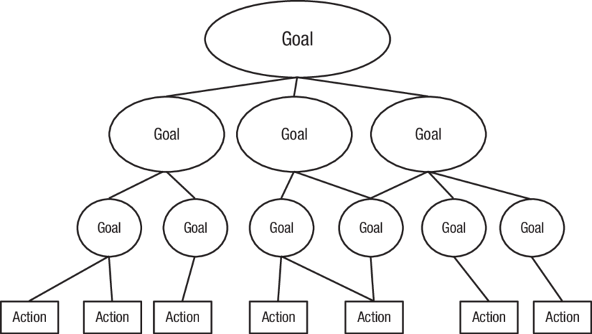
Image by Duckworth & Gross, 2014
Making Goals Personal and Meaningful
A second reason why goals often fail is that the person doesn’t make the goal personal. Often, goals are made that do not reflect the person’s long-term goals or passions. It is important to link your goals to a personal meaning and ask “Why does this matter to me?” In pulling from the example above, the overarching goal of being healthier could matter because the person wants to be able to do certain activities they wouldn’t be able to otherwise, keep up with their kids or grandkids, or live a long happy life. By making these goals more personal, meaning is assigned to them and the motivation will follow.
Use the downloadable "Make It Meaningful" Worksheet to walk through this reflection process.

Building Gentle Discipline
A third reason why some goals fail is that the discipline surrounding said goals is too much or too little. Achieving and working towards your goals shouldn’t feel like a painful chore. Instead, your goals should be built around existing habits or daily rhythms. Billore et al. (2022) explain that self-regulation is critical for long-term behavioral change—and it works best when integrated into daily life rather than forced through harsh self-criticism.
The first way to build gentle discipline is by focusing on your systems and not your willpower alone. One way of doing this would be to cue yourself for different habits. An example of this could be putting your workout clothes by the front door as a physical reminder of the habit.
Another way to build gentle discipline around a habit is by tracking the wins - no matter how small. By giving attention to the small wins, you give yourself the momentum to achieve your larger goals. It’s super important to make sure that if you miss a day or misstep, that you start again. Remember that even if you miss a day, you’re not behind; you’re building a habit that takes time, energy, and practice. Remember, practice makes progress, not perfection.
How to Stay Motivated Without Burning Out
When working towards new goals, your motivation will fluctuate, so it is important to build rest and recovery into your goal system. Your systems should support you on high and low-energy days. An example of how to implement this is if someone makes a goal to work out five times a week, they give themselves three rest days that can be used in place of one of the five workouts throughout the month. This allows conscious decision-making and for the body to rest if needed. It is important to keep your “why” visible! You can do this through journal entries, affirmations, and even vision boards.

Setting goals isn’t a one-time thing. It is a process of evaluating your goals, adjusting habits to match, and celebrating your wins! You don’t need to overhaul your life tonight, but consider taking small, intentional steps towards your goals. Over time, you will be able to see real change in your life. I challenge you, reader, to pick one meaningful goal in your life and give it a shot. The documents below will help walk you through forming your goals and check in with yourself as you try them out. Make sure to give yourself cues and permission to rest. Growth is a journey. We are all striving towards progress, not perfection.
(The linked worksheet is also at the bottom of this page)
“If you want to live a happy life, tie it to a goal, not to people or things.”
References
Billore, S., Anisimova, T., & Vrontis, D. (2023). Self-regulation and goal-directed behavior: A systematic literature review, public policy recommendations, and research agenda. Journal of Business Research, 156, 113435. https://doi.org/10.1016/j.jbusres.2022.113435
Duckworth, A., & Gross, J. J. (2014). Self-control and grit: Related but separable determinants of success. Current Directions in Psychological Science, 23(5), 319–325. https://doi.org/10.1177/0963721414541462
Miller, G. E., & Wrosch, C. (2007). You’ve gotta know when to fold ’em: Goal disengagement and systemic inflammation in adolescence. Psychological Science, 18, 773–777. http://dx.doi.org/10.1111/j.1467-9280.2007.01977.x
Nowack, K. (2017). Facilitating successful behavior change: Beyond goal setting to goal flourishing. Consulting Psychology Journal: Practice and Research, 69(3), 153–171. http://dx.doi.org/10.1037/cpb0000088
Wrosch, C., Scheier, M. F., & Miller, G. E. (2013). Goal adjustment capacities, subjective well-being, and physical health. Social and Personality Psychology Compass, 7, 847–860. http://dx.doi.org/10.1111/spc3.12074
Goal-Setting Worksheet – “Make It Meaningful”
1. What’s your goal? (Write your goal clearly and specifically)
2. Why does this matter to you? (This is your motivation anchor – dig deep!)
3. Is it sustainable?
I have the time to do this: ☐ Yes ☐ No
I feel excited about this: ☐ Yes ☐ No
I’m willing to adjust my routine for this: ☐ Yes ☐ No
4. How will you measure progress? (Examples: journal entries, checkboxes, mini-milestones)
5. What’s your support system? (Who/what will keep you going when motivation dips?)
6. What’s one small step you can take today? (Keep it doable!)
Journal Reflection Page – “Check In With Yourself”
Date: ___________
1. What did I work on today?
2. What felt easy? What felt hard?
3. What am I proud of?
4. Did I take care of myself while working toward my goal?
☐ Yes ☐ No (If not, what can I do differently?)
5. One word to describe how I feel today: __________
6. Tomorrow, I will…