

By Zaya Amarsaikhan
“Finding joy is probably tantamount to finding yourself and being comfortable in your own skin.”
We've all heard the romantic sayings: "We just fit together" or "We're like two peas in a pod." Last Halloween, I saw a couple dressed as peanut butter and jelly sandwiches, sitting on top of each other at the library. Sweet, right?
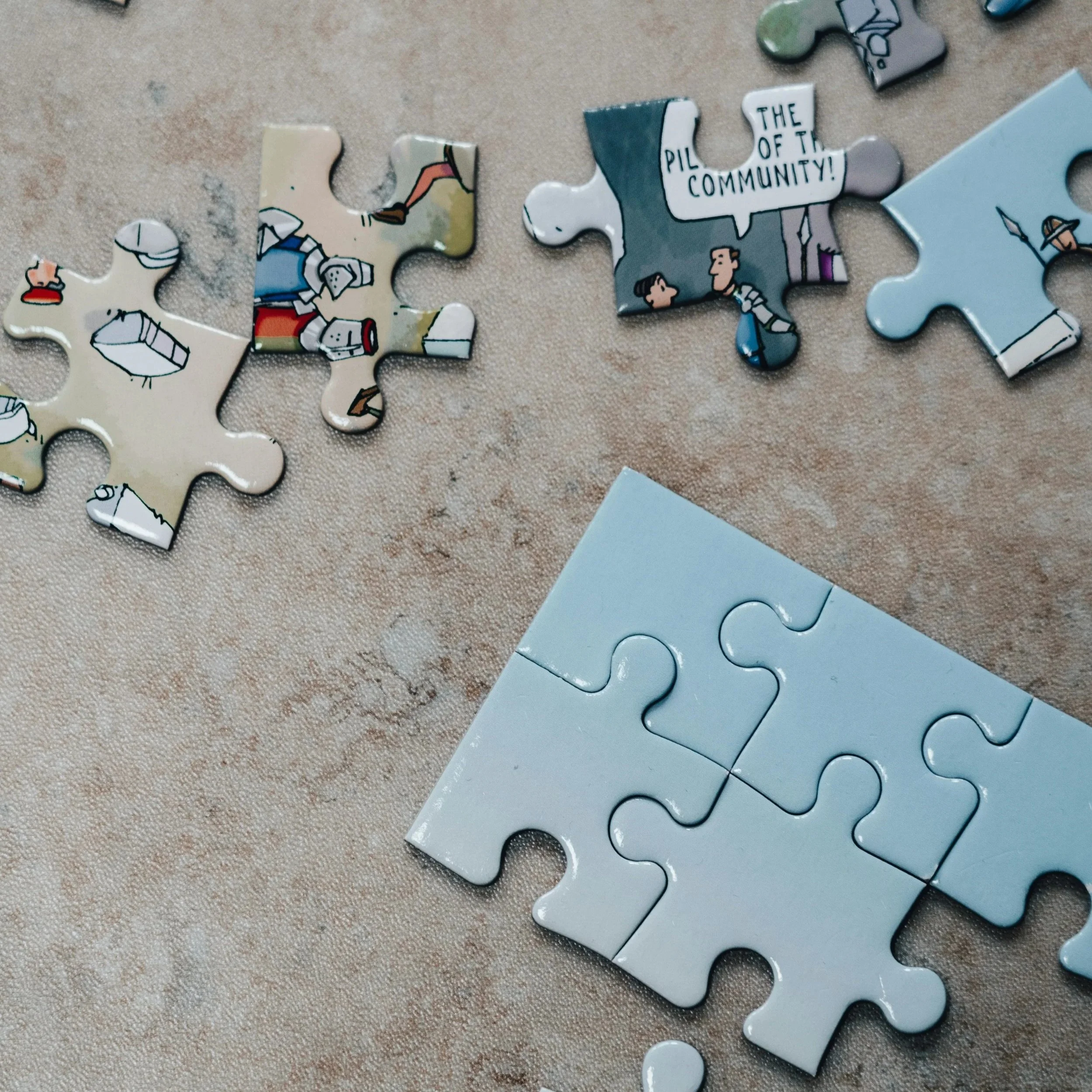
Recently, I was struggling to fit a lid onto a plastic container, growing increasingly frustrated with each failed attempt—only to realize I was using the wrong lid entirely. It struck me: this is exactly how we think about romantic relationships. We believe there's someone out there who's meant to fit us perfectly, like two puzzle pieces clicking together to form a complete, perfect square.
But here's the thing: it's never that simple.

The Marriage Myth
For decades, research suggested that married people were happier and more satisfied with life than singles. But the story is more complicated than we thought. Studies show married men tend to be happier than their wives on average, and divorced men face worse health outcomes than married men—but the same pattern doesn't hold for divorced women (DePaulo & Morris, 2005).
More revealing still, recent research by Spielmann and colleagues (2013) found that people who fear being single are more likely to settle for less responsive, less attractive partners and lower their relationship standards. Fear of being single doesn't just make us unhappy while we're single—it leads us to make worse relationship choices that ultimately decrease our well-being, self-respect, and self-compassion.
Why Can't We Just Be Single?
Why is being single treated like a problem to solve? Young women seeking comfort turn to rom-coms where the heroine's life finally begins when she finds her prince. Social media feeds us a steady diet of relationship content, while friends share stories of partners doing the bare minimum—"he texted you back!"—as though it's extraordinary.
Research shows this cultural obsession has real consequences. The fear of being single is associated with anxious attachment styles and leads people to ignore red flags, settle for unsatisfying relationships, and stay in partnerships that don't serve them (Spielmann et al., 2013). Even after breakups, this fear drives people to renew contact with exes and struggle with healthy detachment.
I experienced this firsthand last Christmas when visiting a city where my ex lives. Before the trip, I was certain I wouldn't reach out. But when I was actually there, not knowing how to spend time alone during the holidays, my old attachment patterns surfaced. I thought, "What if I can never enjoy being single?" That fear almost made me reach out—a choice I now recognize would have been driven by anxiety, not genuine connection.

What Really Drives the Fear
Fear of being single stems from what researchers call "allonormative beliefs"—the internalized, socially prescribed idea that romantic relationships are essential for happiness (Adamczyk, 2017). It's the belief that we need to be in a relationship to be whole, and that being single should cause discomfort and distress.
Here's what the research reveals: this fear doesn't disappear even when you're in a relationship. It keeps people trapped in unsatisfying partnerships and makes them dependent on what we now recognize as toxic dynamics. The fear itself—not your actual relationship status—predicts lower life satisfaction, depression, and sexual dissatisfaction (Spielmann et al., 2013).
The Antidote: Feeling Safe in Your Skin
The solution isn't to frantically install dating apps or force yourself into a relationship. Instead, research points to a paradox: the more comfortable you are being single, the better your eventual relationship outcomes—and the happier you are right now.
Studies show that people who enter relationships from a position of "wanting" (seeking enhancement) rather than "needing" (seeking completion) report higher initial satisfaction, better maintained satisfaction over time, lower rates of disillusionment, and more realistic expectations (Knee et al., 2003). Those with higher self-esteem and life satisfaction set higher standards for partners, show better judgment in assessing compatibility, and experience less pressure to commit prematurely.
In other words: knowing you're whole and happy as you are makes you feel safe in your skin—and that's when you become your best self and make your wisest relationship choices.
Rethinking the Puzzle
Remember our puzzle metaphor? Maybe it's not about two pieces fitting perfectly together. Maybe the complete picture requires all the puzzle pieces—your friends, family, community, creative pursuits, values, and yes, potentially a romantic partner too.
We don't need just one person to complete us. We need connection, period. Each of us is a unique piece of the larger human experience. The longing for love and partnership that drives our fear of being single? That's actually a longing for meaning, belonging, and connection—things we can cultivate in multiple ways.
Practical Steps to Feel Safe in Your Skin
Research shows several approaches effectively reduce fear of being single and build genuine self-security:
Challenge fear-based thoughts. When you catch yourself thinking "I need a partner to be worthy/complete/happy," pause and examine the evidence. Ask yourself: What alternative thought would be more accurate? Try: "I'm building a full life now that will enhance future relationships" (DePaulo & Morris, 2006).
Rewrite your narrative. Instead of viewing single periods as gaps or waiting rooms, reconstruct them as chapters of growth and self-discovery. Your story isn't "waiting for my life to start"—it's "building the life I want to live" (Wilson & Ross, 2003).
Practice self-compassion. Treat yourself with the same kindness you'd offer a friend who's single and worried. Research by Neff and Germer (2013) shows self-compassion training reduces relationship anxiety and the need for external validation.
Build non-romantic connections. The antidote to loneliness isn't necessarily romantic love. Studies show that improving the quality (not quantity) of existing friendships and family relationships alleviates loneliness and reduces desperate partner-seeking (Cacioppo et al., 2015). Building identity around multiple group memberships—your book club, your work team, your running group—buffers against relationship status distress (Haslam et al., 2018).
Live your values now. Identify what matters to you beyond romantic relationships. Travel solo. Go to restaurants alone. Attend events independently. These aren't activities to endure until you're partnered—they're evidence that your solo life can be rich and meaningful.
Connect broadly. Invite meaning and connection into your life through relationships with friends, siblings, coworkers, even the receptionist at your gym. Make eye contact with strangers' dogs. Notice the moon. Practice savoring the connections already around you.
The Empowering Paradox
Here's the beautiful irony the research reveals: people who report they "don't need" a relationship are more likely to form satisfying ones when they do partner. Those who rate themselves as "complete" while single show better relationship outcomes than those seeking completion through others. Singles who invest in personal growth and friendships transition into higher-quality romantic relationships than those fixated on finding partners (Joel et al., 2020).
The universe doesn't smile upon you when you find the perfect person. It smiles upon you when you feel safe in your own skin—whole, worthy, and connected to the larger human experience. From that foundation, you can choose relationships that truly enhance your life rather than frantically seeking ones to complete it.
Maybe that's the meaning we're all searching for.
“There are some places in life where you can only go alone. Embrace the beauty of your solo journey.”
References
Adamczyk, K. (2017). Direct and indirect effects of relationship status through fear of being single and satisfaction with singlehood on Polish young adults' life satisfaction. Personality and Individual Differences, 111, 51-57.
Cacioppo, S., Grippo, A. J., London, S., Goossens, L., & Cacioppo, J. T. (2015). Loneliness: Clinical import and interventions. Perspectives on Psychological Science, 10(2), 238-249.
DePaulo, B. M., & Morris, W. L. (2005). Singles in society and in science. Psychological Inquiry, 16(2-3), 57-83.
DePaulo, B. M., & Morris, W. L. (2006). The unrecognized stereotyping and discrimination against singles. Current Directions in Psychological Science, 15(5), 251-254.
Haslam, C., Jetten, J., Cruwys, T., Dingle, G. A., & Haslam, S. A. (2018). The new psychology of health: Unlocking the social cure. Routledge.
Joel, S., Eastwick, P. W., Allison, C. J., Arriaga, X. B., Baker, Z. G., Bar-Kalifa, E., ... & Wolf, S. (2020). Machine learning uncovers the most robust self-report predictors of relationship quality across 43 longitudinal couples studies. Proceedings of the National Academy of Sciences, 117(32), 19061-19071.
Knee, C. R., Patrick, H., & Lonsbary, C. (2003). Implicit theories of relationships: Orientations toward evaluation and cultivation of romantic relationships. Personality and Social Psychology Review, 7(1), 41-55.
Neff, K. D., & Germer, C. K. (2013). A pilot study and randomized controlled trial of the mindful self-compassion program. Journal of Clinical Psychology, 69(1), 28-44.
Spielmann, S. S., MacDonald, G., Maxwell, J. A., Joel, S., Peragine, D., Muise, A., & Impett, E. A. (2013). Settling for less out of fear of being single. Journal of Personality and Social Psychology, 105(6), 1049-1073.
Wilson, A. E., & Ross, M. (2003). The identity function of autobiographical memory: Time is on our side. Memory, 11(2), 137-149.